MateSel: Driving Genetic Progress in Wagyu Breeding

MateSel: Driving Genetic Progress in Wagyu Breeding

The advancement of Wagyu genetics depends on breeding strategies that balance rapid genetic gain with long-term diversity and sustainability. For breeders aiming to strengthen traits such as marbling, fertility, and growth, MateSel provides a powerful tool to design data-driven, customised breeding programs.

What is MateSel?

MateSel is a software package developed by Professor Brian and Sandy Kinghorn from the University of New England in Armidale, NSW, to optimise selection and mating decisions in a breeding program. At its core, it uses Optimal Contributions Selection (OCS), a method that ensures maximum genetic progress while controlling inbreeding and maintaining long term herd diversity.

Already widely adopted across industries such as beef, sheep, dairy, pigs, aquaculture, forestry, and crops, MateSel is also a key driver of genetic progress in Wagyu breeding.

How Does MateSel Work?

MateSel combines genetic evaluations (such as EBVs and genomic data) with breeder-specified constraints to generate a ranked set of matings. Its flexibility means it can accommodate both technical goals and on-farm logistics. Key capabilities include:

  • Managing genetic defects by avoiding carrier-to-carrier matings.
  • Managing trait distributions with Tactical Desired Gains, ensuring balanced progress across carcase, fertility, and growth traits.
  • Integrating reproductive technologies such as Artificial Insemination (AI), In-Vitro Fertilisation (IVF), and Embryo Transfer (ET).
  • Handling practical constraints like animal movement, semen/embryo availability, joining numbers, and patterns of mating.
  • Using genomic information to increase accuracy in both selection and mating allocations.

By modelling thousands of possible combinations, MateSel provides a mating plan that reflects both the breeder’s long-term objectives and short-term operational needs.


The software creates a frontier, which reflects the emphases on $Index (e.g BFI) v Diversity (i.e Coancestry).
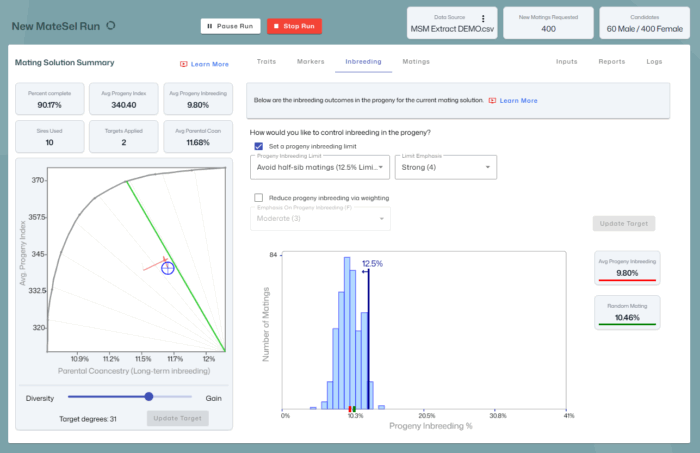
 

Restrictions can be imposed on different traits (EBVs) (e.g in crease mean marble score of progeny).
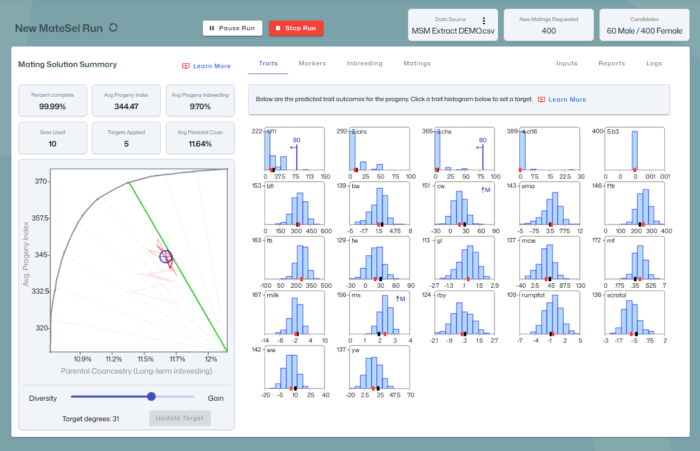
 

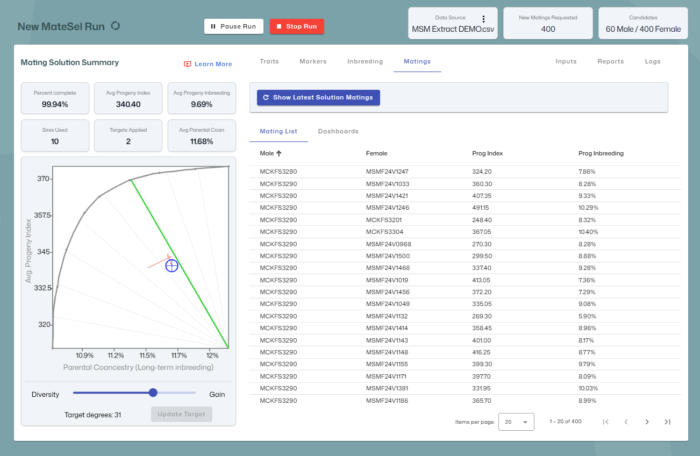
Once the run is completed, a list of matings with the progeny $Index and progeny inbreeding is provided.
 

Benefits for Wagyu Breeding

Wagyu breeders face unique challenges, the breed’s global reputation depends on exceptional marbling and meat quality, while genetic diversity must be carefully preserved due to reliance on a relatively narrow gene pool. MateSel addresses these challenges by:

  • Maximising genetic gain in high-value traits such as marbling, carcase weight, and eating quality.
  • Maintaining genetic diversity, reducing the risk of inbreeding depression in future generations.
  • Allowing tactical breeding decisions, such as increasing fertility while maintaining carcase quality.
  • Integrating seamlessly with genomic testing and BREEDPLAN EBVs, delivering evidence-based recommendations.

The Future of Wagyu Genetic Improvement

As genomic testing expands and EBVs become more powerful, MateSel will continue to underpin the Wagyu industry’s progress. By combining Optimal Contributions Selection with practical on-farm constraints, the software ensures that breeding decisions today will secure both profitability and genetic sustainability for the future.

To find out more about how MateSel can work for your Wagyu herd, contact AWA MSO Team E: [email protected]
 

IMPORTANT NOTICE - Terms & Conditions


It is a condition of use of this database that you accept these terms and conditions. 

It is important that you appreciate when accessing the Australian Wagyu Association Limited (AWA) database (which may be hosted on an external website) that the information contained on the AWA database, including but not limited to pedigree, DNA information, Wagyu Breeding Values (WBVs) and Index values (together called Database Information), is based on data supplied by AWA members and/or third parties. 

Whilst sincere effort is made to ensure the Database Information is accurate and complete, to the extent permitted by law, AWA, its officers and employees, shall not be responsible for its use or interpretation, and you use the Database Information at your own risk. Please be aware of the following limitations of the Database Information.  

Regarding WBVs and Index values, it is important to appreciate, and you need to be aware that: 

  • WBVs are derived using genetic evaluation technology developed for the AWA, using the information contained within the AWA database. 
  • WBVs are estimates of genetic potential of individual animals and may not reflect the raw animal phenotype. 
  • WBVs can only be directly compared to other WBVs calculated in the same AWA genetic analysis. 

Regarding pedigree and DNA testing results submitted to the AWA, it is important to appreciate, and you need to be aware that: 

  • Animals whose registration identifiers start with PED are Pedigree Recorded Animals. What this means is that the details which AWA used to register the animal were obtained from a Recognised Wagyu Registry Organisation – in other words a Wagyu breed association based outside of Australia. AWA has not independently verified the information with respect to the animal or the details recorded about the animal. You should read AWA’s by-laws which set out details regarding the definition of a Pedigree Recorded Animal. 
  • Pedigree and DNA data submitted and supplied to AWA may have errors in it which cannot be detected without further DNA testing. 
  • Technology may have advanced since a particular test was undertaken so that genetic issues or inaccuracies which were previously not detectable are now able to be detected by current testing technology (i.e. if the animal was tested again with current technology). 
  • AWA estimates that less than 1% of the pedigree entries, ownership or breeding details in the AWA Herdbook may have errors or which may be misleading. For this reason, users ought to consider if they need to obtain independent testing of the relevant animal (if possible) to ensure that the data is accurate. 

Regarding prefectural content, it is important to appreciate, and you need to be aware that: 

  • Prefectural content is based on the estimation of prefectural origin from Japanese breeding records of 201 foundation sires and 168 foundation dams. As genotype-based parent verification is not used in Japan, and full Japanese registration certificates are not available for all foundation animals, exact prefectural composition for these sires and dams cannot be validated. 
  • The calculation of prefectural content for Australian Herdbook animals relies on the accuracy of pedigree records and DNA samples provided by AWA members.   

Regarding DNA testing and genetic condition results submitted to the AWA, it is important to appreciate, and you need to be aware that: 

  • As genetic testing results are provided by independent DNA testing laboratories at the request of AWA members, AWA relies solely on the accuracy of the reporting of genetic testing as completed by the laboratories. 
  • AWA uses GeneProb software to calculate the likelihood of pedigree animals being a carrier of genetic conditions.  This likelihood is an estimate based on the available genetic testing results. 

If you consider that you do not understand or appreciate the nature and/or implications of the data provided on this website or the WBVs of a particular animal, then AWA strongly recommends that you seek expert advice.  Note there is substantial technical information and articles on the Wagyu website to assist our members. 

AWA’s liability for any loss or damage, consequential or otherwise, suffered or incurred by you or your related business, arising directly or indirectly from your use of Database Information, to the extent permitted by law, is limited to AWA providing you with a refund for the fees paid for the service (if any), or AWA re-performing the service, where possible, at the election of AWA.  

AWA administers this database in good faith to support AWA members and the industry. AWA does not represent or warrant that the animals recorded in this database, or animals breed from them, will achieve any particular genetic or phenotype performance.


THIS DISCLAIMER HAS BEEN UPDATED AS OF 03/02/2026, PLEASE ENSURE YOU HAVE READ IT IN DETAIL