Wagyu-Specific Improvement in Maternal Trait Evaluation
Introduction
One of the most important changes accompanying the Australian Wagyu Association’s (AWA) transition from Estimated Breeding Values (EBVs) to Wagyu Breeding Values (WBVs) is the replacement of the long-standing Milk EBV with a new trait: Maternal Weaning Weight WBV.
While often referred to as “Milk,” the prior EBV was never a direct measure of milk production. Advances in Wagyu-specific data, modelling, and biological understanding now allow AWA to more accurately describe and evaluate maternal performance through a trait that better reflects what is actually observed in Wagyu production systems
What the Milk EBV Represented
In BREEDPLAN, the Milk EBV was defined as the maternal contribution to a calf’s 200-day weight, not milk yield itself. This contribution includes:
- Milk production
- Maternal behaviour and temperament
- Mothering ability
- The dam’s ability to support calf growth up to weaning
Over time, the term “Milk” led to widespread misunderstanding, with many breeders interpreting the EBV as a direct estimate of lactation performance.
Limitations of the Prior Milk EBV in Wagyu
As AWA’s Wagyu dataset expanded, several technical limitations of the Milk EBV became evident resulting from inaccurate trait relationships.
Analysis of Wagyu data showed that the BREEDPLAN Milk EBV had little to no meaningful genetic relationship with most growth, fertility, and carcase traits, except for birth weight measures and gestation length. This pattern did not align with observed Wagyu performance in commercial and seedstock herds. Anecdotal and performance-based feedback from Wagyu breeders consistently indicated that Milk EBVs were often a poor predictor of actual maternal performance observed in the paddock.
Why Maternal Weaning Weight Is a Better Trait
The Maternal Weaning Weight WBV replaces the Milk EBV to more accurately describe what is being measured and to a Wagyu-specific underlying genetic model.
A Clearer Biological Definition
Maternal Weaning Weight represents the maternal genetic effect on calf growth to weaning, independent of:
- The calf’s own growth genetics
- Environmental and management effects
This definition removes ambiguity and aligns the trait name with its biological meaning.
Wagyu-Specific Genetic Parameters
Unlike the Milk EBV, Maternal Weaning Weight WBVs are calculated using:
- Wagyu-only heritabilities and genetic correlations
- Full multi-trait models incorporating growth, fertility, and carcase traits
As a result, Maternal Weaning Weight shows:
- Positive genetic relationships with growth and fertility traits
- Expected relationships with gestation length
- Slight negative relationships with some marbling traits, reflecting real biological trade-offs in Wagyu systems
Relationship Between Milk EBVs and Maternal Weaning Weight WBVs
Comparative analyses demonstrate that Milk EBVs and Maternal Weaning Weight WBVs are strongly but not perfectly correlated.
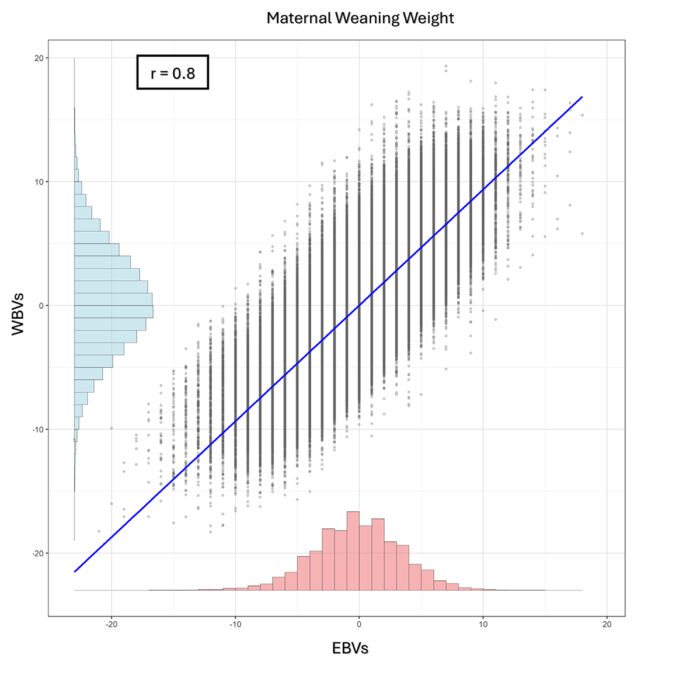
Figure 1. Distribution and Correlation of Milk EBVs (x axis) and Maternal Weaning Weight WBVs (y axis) for all animals.
Across the entire population, the correlation between Milk EBVs and Maternal Weaning Weight WBVs is approximately 0.8, indicating that animals ranked highly for Milk generally remain strong maternal animals. However, the weaker correlation means:
- Some animals re-rank significantly
- Differences are most evident in animals with lower EBV accuracy
- High-accuracy, widely used sires show stronger alignment (correlations ~0.85)
These re-rankings reflect changes in the genetic parameters within AWA’s new Wagyu-specific model.
Practical Implications for Breeders
What Stays the Same
- The trait still measures maternal contribution to calf growth to weaning
- Interpretation remains comparative (higher = stronger maternal effect)
- Accuracy remains a key consideration in selection decisions
What Improves
- Clearer trait definition and communication
- Better alignment with observed paddock performance
- More reliable selection for maternal functionality without unintended bias
- Improved balance between maternal performance and carcase outcomes
Why This Change Is Only Possible Now
The replacement of Milk EBV with Maternal Weaning Weight WBV is only possible because AWA now has:
- A much larger Wagyu-specific dataset
- Substantially increased genomic coverage
- Independent control of genetic evaluation models
- The ability to update parameters based on Wagyu data alone
Conclusion
The transition from Milk EBV to Maternal Weaning Weight WBV represents a refinement in maternal trait evaluation. The prior Milk EBV was the best available tool at the time, but advances in data, genomics, and analytical capability now allow AWA to deliver a more biologically accurate, Wagyu-specific maternal trait.