Genetic Diversity

WHAT IS A GENETIC DIVERSITY SCORE

Genomic Diversity Scores can now be calculated for all Japanese Black Fullblood animals registered with the AWA. This is achieved by computing a Genomic Relationship Matrix (GRM), which calculates pairwise comparisons of the individual SNP similarities between all animals in the genomic database. This allows us to understand how each animal is genomically related to every other animal in the database. Animals which are closely related to the population have low Genomic Diversity Scores.

CALCULATING GENETIC DIVERSITY

Firstly, you need a genomic SNP profile. It is important to note that a Genomic Diversity Score can only be calculated from genomic profiles (not MiP, STR or parentage SNP) and therefore, not all animals will get a Diversity Score calculated.

The Diversity Score is calculated by analysing the SNP by SNP similarity in an individual to the reference population. The reference population is set as the last five calendar years of registered Fullblood Japanese Black females, which will be approximately 70% of the future breeding population.

The Diversity Score gets calculated in three steps:

1. the average of the animal’s relationship to all animals in the reference population gets calculated; then

2. this value gets inversed to result in higher values indicating more diversity (low genomic relationship to the reference population); and

3. the value is expressed between 0 and 100, with 0 being lowest diversity and 100 being highest diversity.

Genomic Diversity Scores can currently only be calculated for Fullblood Japanese Black animals that have a genomic profile. We do not have appropriate reference populations for Red Wagyu, Purebred or content populations.

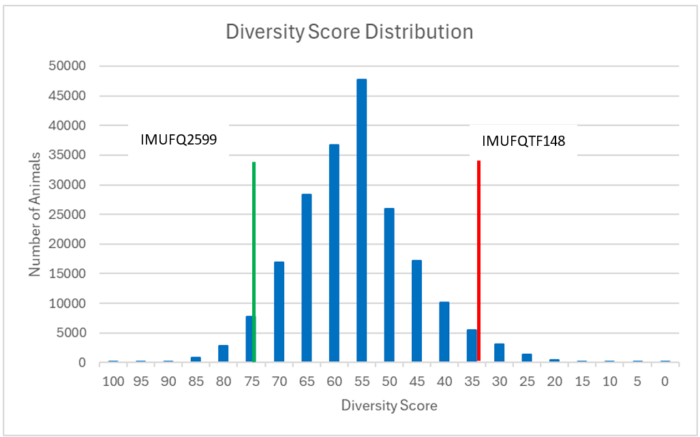
Examples: Genomic Diversity Scores can assist breeders to identify animals that are relatively unrelated to the reference population. This could be used to select unrelated sires to a female herd, to reduce the inbreeding levels in offspring. The following figure shows the distribution of Diversity Scores in all Japanese Black Fullblood registered sires compared to females registered in the last 5 years.

The Diversity Score Distribution graph shows that on average, the sire population has a Diversity Score average close to 50, but some animals have low diversity (eg. 25 or below) and are similar to the average of the current breeding female population. Some sires have high diversity (75 or above) and are genetically diverse from the average of the current female breeding population.

The foundation sire TF Yukiharunami 4 (IMUFQ2599) is highlighted in GREEN. He has 997 total progeny registered with the AWA, but only 24 females registered with the AWA within the last 5 calendar years. His genetic diversity score is relatively high compared to the current female breeding population.

For comparison, the foundation sire Itoshigenami (TF148) is shown is highlighted in RED. He has 7,797 progeny registered with the AWA, with 184 females registered with the AWA in the last 5 calendar years. TF148 has also sired many second and third generation influential sires that have high numbers of progeny registered within the last 5 calendar years. His genetic diversity score is relatively low compared to the current female breeding population.
 

Genetic Diversity

Implications: When selecting bull calves for future breeding, a breeder can incorporate the Genomic Diversity Score as a selection criterion and decide to keep some high diversity calves as bulls even though their EBVs may only be average. This will help to increase genetic diversity and contain inbreeding in the future.

A breeder may also rank sires based on EBVs for a particular trait and then sorting them from highest to lowest Genomic Diversity to make science-based decisions on selecting breeding animals which are genomically different from the current cohort of breeding animals for the given level of EBVs.

The ability to calculate Genomic Diversity for suggested matings during a Matesel analysis is currently under development. This will improve a breeder’s ability to identify mating which would produce progeny with high genomic diversity at desired trait performance levels.

Implementation: Genomic Diversity will be published for all Fullblood Japanese Black animals with genomic (100K) profiles held by the AWA. It is not currently possible to analyse Genomic Diversity in Purebred, Wagyu content or in Red Wagyu animals due to the lack of effective reference populations.

Breeders will be able to use Genomic Diversity to assist in managing inbreeding and to accurately select for animals that provide true genetic diversity to their breeding herds.
IMPORTANT NOTICE - Terms & Conditions


It is a condition of use of this database that you accept these terms and conditions. 

It is important that you appreciate when accessing the Australian Wagyu Association Limited (AWA) database (which may be hosted on an external website) that the information contained on the AWA database, including but not limited to pedigree, DNA information, Wagyu Breeding Values (WBVs) and Index values (together called Database Information), is based on data supplied by AWA members and/or third parties. 

Whilst sincere effort is made to ensure the Database Information is accurate and complete, to the extent permitted by law, AWA, its officers and employees, shall not be responsible for its use or interpretation, and you use the Database Information at your own risk. Please be aware of the following limitations of the Database Information.  

Regarding WBVs and Index values, it is important to appreciate, and you need to be aware that: 

  • WBVs are derived using genetic evaluation technology developed for the AWA, using the information contained within the AWA database. 
  • WBVs are estimates of genetic potential of individual animals and may not reflect the raw animal phenotype. 
  • WBVs can only be directly compared to other WBVs calculated in the same AWA genetic analysis. 

Regarding pedigree and DNA testing results submitted to the AWA, it is important to appreciate, and you need to be aware that: 

  • Animals whose registration identifiers start with PED are Pedigree Recorded Animals. What this means is that the details which AWA used to register the animal were obtained from a Recognised Wagyu Registry Organisation – in other words a Wagyu breed association based outside of Australia. AWA has not independently verified the information with respect to the animal or the details recorded about the animal. You should read AWA’s by-laws which set out details regarding the definition of a Pedigree Recorded Animal. 
  • Pedigree and DNA data submitted and supplied to AWA may have errors in it which cannot be detected without further DNA testing. 
  • Technology may have advanced since a particular test was undertaken so that genetic issues or inaccuracies which were previously not detectable are now able to be detected by current testing technology (i.e. if the animal was tested again with current technology). 
  • AWA estimates that less than 1% of the pedigree entries, ownership or breeding details in the AWA Herdbook may have errors or which may be misleading. For this reason, users ought to consider if they need to obtain independent testing of the relevant animal (if possible) to ensure that the data is accurate. 

Regarding prefectural content, it is important to appreciate, and you need to be aware that: 

  • Prefectural content is based on the estimation of prefectural origin from Japanese breeding records of 201 foundation sires and 168 foundation dams. As genotype-based parent verification is not used in Japan, and full Japanese registration certificates are not available for all foundation animals, exact prefectural composition for these sires and dams cannot be validated. 
  • The calculation of prefectural content for Australian Herdbook animals relies on the accuracy of pedigree records and DNA samples provided by AWA members.   

Regarding DNA testing and genetic condition results submitted to the AWA, it is important to appreciate, and you need to be aware that: 

  • As genetic testing results are provided by independent DNA testing laboratories at the request of AWA members, AWA relies solely on the accuracy of the reporting of genetic testing as completed by the laboratories. 
  • AWA uses GeneProb software to calculate the likelihood of pedigree animals being a carrier of genetic conditions.  This likelihood is an estimate based on the available genetic testing results. 

If you consider that you do not understand or appreciate the nature and/or implications of the data provided on this website or the WBVs of a particular animal, then AWA strongly recommends that you seek expert advice.  Note there is substantial technical information and articles on the Wagyu website to assist our members. 

AWA’s liability for any loss or damage, consequential or otherwise, suffered or incurred by you or your related business, arising directly or indirectly from your use of Database Information, to the extent permitted by law, is limited to AWA providing you with a refund for the fees paid for the service (if any), or AWA re-performing the service, where possible, at the election of AWA.  

AWA administers this database in good faith to support AWA members and the industry. AWA does not represent or warrant that the animals recorded in this database, or animals breed from them, will achieve any particular genetic or phenotype performance.


THIS DISCLAIMER HAS BEEN UPDATED AS OF 03/02/2026, PLEASE ENSURE YOU HAVE READ IT IN DETAIL