
A10 Geneprob Availability via Helical

The Australian Wagyu Association advises members that A10 (ANXN10) GeneProb results are now available through Helical, via a special project with Neogen Australasia. 

Through their long-term collaborative partnership, Neogen Australasia assisted in generating A10 results on 853 influential sires that seeded the Geneprob evaluation. Through this work, 23 A10 carriers were identified, supporting the development and accuracy of the predictive analysis now available to members. 

As part of their ongoing commitment to the AWA membership, Neogen Australasia is offering an introductory offer with discounted pricing for the next six weeks, with details at the bottom of the email. 

Impact of A10 

Research from Japan identified that female carriers of the Annexin A10 mutation have higher rates of pregnancy termination, resulting from higher incidence of embryo mortality in the first 60 days following insemination.  

What influential animals are carriers of A10, and what is the carrier frequency in the Wagyu population?  

Following the sire testing project with Neogen Australasia, SHIGESHIGETANI (WKSFP1593) was found to be a carrier of A10.  SHIFGESHIGETANI has 2,543 recorded progeny.  His A10 carrier status was inherited from his dam, SUZUTANI (WKSFL0976), who is also a carrier from Geneprob assessment. His sire, HARUKI 2 (WKSFM0139), is A10 free (not a carrier) from lab results.  

Other influential animals found to be carriers of A10 are: 

KIKUTERISHIGE (IMUFMTF150), a Foundation sire with 1,206 recorded progeny. 

LONGFORD Y004 (LFDFY0004), a sire with 923 recorded progeny tracing back to KANADAGENE IMUFP0102 and SUZUTANI. 

JVP YASUTANIYOSHI (IMUFQ0408), an imported sire with 128 progeny. 

Significant numbers of Red Wagyu (Akaushi) have not been tested to date, however ARWFH0015, a Composite Red x Black Wagyu cross has been found to be a carrier of A10 from the dam side, with his Black Wagyu sire side lineage known to be free of A10.  This indicates that the Annexin A10 mutation is also found in the Red Wagyu population. 

The estimated carrier frequency in the Wagyu population recorded with the AWA sits at 4.8 % for the 2025 born calves. This has increased from 3.5% when compared to the 2015 born calves, reflecting the recent increased use of SHIGESHIGETANI and progeny of his within the breeding population. 
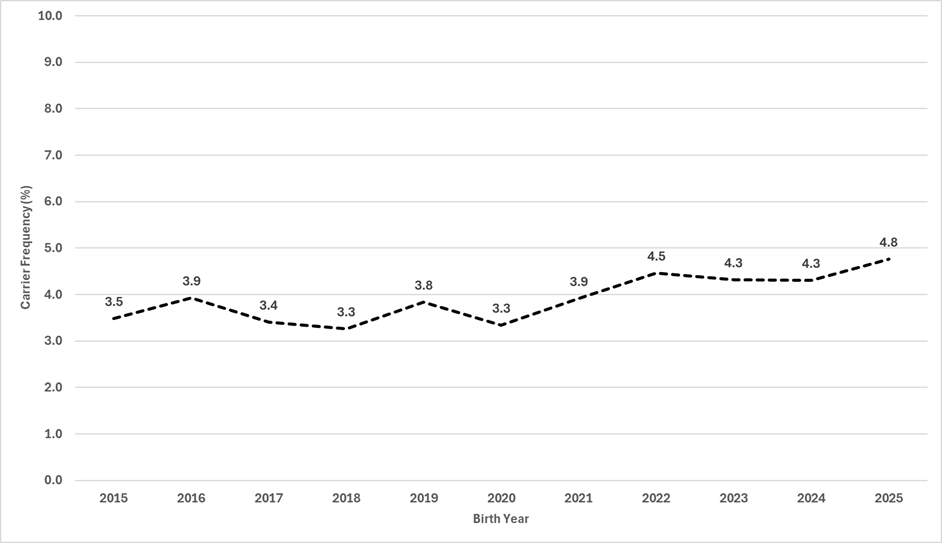
Figure 1 – A10 Carrier Frequency in the AWA recorded Wagyu population. 


What is GeneProb? 

GeneProb is a predictive tool that estimates the likelihood (expressed as a percentage) that an animal carries a recessive genetic condition. These estimates are based on pedigree information and available test results, providing valuable insight for animals that have not been directly tested. 

GeneProb analyses are updated weekly, with revised results published each Friday. 

Currently, GeneProb is calculated for: 

  • B3 
  • CHS 
  • CL16 
  • F11 
  • IARS 
  • ANXN10 (A10) 

Results are only displayed for animals without a direct laboratory test result. 

For more on GeneProb see Understanding Genetic Condition Results and GeneProb | Australian Wagyu Association 

What is ANXN10 (A10)? 

Annexin A10 (ANXN10) is a genetic variant associated with embryonic mortality in cattle, particularly during the early stages of pregnancy. It is considered a maternal-effect genetic factor, contributing to early pregnancy loss or reduced embryo viability and thereby lowering calving rates and overall reproductive efficiency in affected herds. 

The condition appears to have its greatest impact in carrier females, while animals inheriting two copies of the mutation are not thought to survive to term, suggesting the homozygous state is likely lethal.  

For more on A10 see Annexin A10 (ANXN10) | Australian Wagyu Association 


Neogen Introductory Offer 

To support AWA members, Neogen is offering special introductory A10 testing: 

  • Standalone A10 testing: $22 + GST
    Any sample type accepted
    No sample pull fees on existing samples for the duration of the offer
    Offer applies to submissions received between now and 26 June 

 Please note that this offer is currently available only to Australian laboratory submissions and Australian members. It does not extend to laboratories in the United States or other international locations at this stage. International members can access A10 testing through Weatherbys. 


A10 Testing options 

A10 is now able to be tested through the AWA partnerships with both Weatherbys and Neogen Australasia. For further detail on the associated pricing please refer to the AWA fee schedule – Fee Schedule – Australian Wagyu Association | Australian Wagyu Association 

For further information on testing for A10 or accessing Geneprob results through Helical, please contact the AWA team 02 8880 7700 or [email protected], or our genotyping partners, Neogen Australasia or Weatherbys.  

IMPORTANT NOTICE - Terms & Conditions


It is a condition of use of this database that you accept these terms and conditions. 

It is important that you appreciate when accessing the Australian Wagyu Association Limited (AWA) database (which may be hosted on an external website) that the information contained on the AWA database, including but not limited to pedigree, DNA information, Wagyu Breeding Values (WBVs) and Index values (together called Database Information), is based on data supplied by AWA members and/or third parties. 

Whilst sincere effort is made to ensure the Database Information is accurate and complete, to the extent permitted by law, AWA, its officers and employees, shall not be responsible for its use or interpretation, and you use the Database Information at your own risk. Please be aware of the following limitations of the Database Information.  

Regarding WBVs and Index values, it is important to appreciate, and you need to be aware that: 

  • WBVs are derived using genetic evaluation technology developed for the AWA, using information contained within the AWA database and parameters derived from it.
  • WBVs are estimates of genetic potential of individual animals and may change with addition of new data or with new parameters.
  • WBVs are genetic merit estimates only and may not reflect the raw animal phenotype.
  • WBVs can only be directly compared to other WBVs calculated in the same AWA genetic analysis.

Regarding pedigree and DNA testing results submitted to the AWA, it is important to appreciate, and you need to be aware that: 

  • Animals whose registration identifiers start with PED are Pedigree Recorded Animals. What this means is that the details which AWA used to register the animal were obtained from a Recognised Wagyu Registry Organisation – in other words a Wagyu breed association based outside of Australia. AWA has not independently verified the information with respect to the animal or the details recorded about the animal. You should read AWA’s by-laws which set out details regarding the definition of a Pedigree Recorded Animal. 
  • Pedigree and DNA data submitted and supplied to AWA may have errors in it which cannot be detected without further DNA testing. 
  • Technology may have advanced since a particular test was undertaken so that genetic issues or inaccuracies which were previously not detectable are now able to be detected by current testing technology (i.e. if the animal was tested again with current technology). 
  • AWA estimates that less than 1% of the pedigree entries, ownership or breeding details in the AWA Herdbook may have errors or which may be misleading. For this reason, users ought to consider if they need to obtain independent testing of the relevant animal (if possible) to ensure that the data is accurate. 

Regarding prefectural content, it is important to appreciate, and you need to be aware that: 

  • Prefectural content is based on the estimation of prefectural origin from Japanese breeding records of 201 foundation sires and 168 foundation dams. As genotype-based parent verification is not used in Japan, and full Japanese registration certificates are not available for all foundation animals, exact prefectural composition for these sires and dams cannot be validated. 
  • The calculation of prefectural content for Australian Herdbook animals relies on the accuracy of pedigree records and DNA samples provided by AWA members.   

Regarding DNA testing and genetic condition results submitted to the AWA, it is important to appreciate, and you need to be aware that: 

  • As genetic testing results are provided by independent DNA testing laboratories at the request of AWA members, AWA relies solely on the accuracy of the reporting of genetic testing as completed by the laboratories. 
  • AWA uses GeneProb software to calculate the likelihood of pedigree animals being a carrier of genetic conditions.  This likelihood is an estimate based on the available genetic testing results. 

If you consider that you do not understand or appreciate the nature and/or implications of the data provided on this website or the WBVs of a particular animal, then AWA strongly recommends that you seek expert advice.  Note there is substantial technical information and articles on the Wagyu website to assist our members. 

AWA’s liability for any loss or damage, consequential or otherwise, suffered or incurred by you or your related business, arising directly or indirectly from your use of Database Information, to the extent permitted by law, is limited to AWA providing you with a refund for the fees paid for the service (if any), or AWA re-performing the service, where possible, at the election of AWA.  

AWA administers this database in good faith to support AWA members and the industry. AWA does not represent or warrant that the animals recorded in this database, or animals breed from them, will achieve any particular genetic or phenotype performance.


THIS DISCLAIMER HAS BEEN UPDATED AS OF 03/02/2026, PLEASE ENSURE YOU HAVE READ IT IN DETAIL