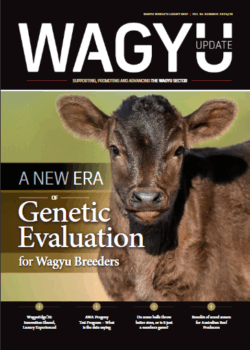
The Wagyu industry has always been at the forefront of innovation. As demand grows domestically and globally for premium Wagyu beef, so too does the need for more precise and effective genetic tools.
In 2026, the Australian Wagyu Association (AWA) is taking a major step forward by transitioning from the well-known BREEDPLAN Estimated Breeding Values (EBVs) to a new, Wagyu-tailored system: Wagyu Breeding Values (WBVs).
This evolution represents far more than a change in terminology, it is a fundamental upgrade in how Wagyu genetics are understood, compared, and utilised to drive profitability and sustainability for breeders and the entire Wagyu value chain.
Why Change Was Needed
BREEDPLAN has served the AWA and Australian beef industry for decades, providing a powerful framework for analysing pedigree, performance, and genomic data. However, Wagyu has always been a unique breed, using genomics as a backbone to their herdbook, distinctive traits, with specialised production systems, and a different economic value structure compared to other beef breeds.
Several limitations became increasingly clear:
- Better use of Crossbred data, with thousands of F1 to F3 carcase records being added to AWA’s database each year, this required a more inclusive and advanced model that was better able to utilise the value of crossbred data.
- New and updated traits, with the amount of new data that AWA is acquiring each year, with Wagyu specific camera and meat quality traits, the Wagyu breed needs a more agile and flexible system to adapt to its members’ needs in a timely manner.
- Rapid increases in genomic testing within the Wagyu industry demanded a system better able to harness high-density SNP data from animals with different levels of Wagyu content that all need to be used within AWA’s genetic evaluation.
- Higher frequency and streamlined delivery of results, members are demanding fast turnaround times from data submission to results being generated and published.
- Most importantly, Wagyu-specific trait definitions and indexes were needed to reflect the unique attributes of Wagyu and the realities of fullblood, purebred and crossbred Wagyu production systems.
WBVs were developed in response to these needs following a 4-year program of system renewal to create AWA’s future operational platform.
What Are WBVs?
Wagyu Breeding Values (WBVs) are AWA’s new genetic evaluation outputs, designed specifically for animals in the Wagyu herdbook and for Wagyu commercial production systems. They are developed in-house with state-of-the-art software by a team of experienced geneticists, using Wagyu data and parameters, Wagyu-specific models, and economic weights tailored for the premium beef supply chain.
Key features include:
- A Wagyu specific genetic evaluation
WBVs are generated from the largest Wagyu dataset in the world with half a million genotypes, and more than 50,000 carcase records. This allows:
- More accurate predictions for high value carcase traits
- Better modelling of breed-specific growth curves
- Enhanced utilisation of high-density genomic data
- Expanded and improved carcase trait modelling
Carcase traits, including Marbling Score, Marbling Fineness, Eye Muscle Area, Rib Fat, and Carcase Weight benefit from improved genetic parameters derived solely from Wagyu phenotypes run in a full multi-trait model.
- Greater accuracy through genomics
WBVs incorporate genomic information more efficiently, utilizing genotypes from all animals with Wagyu content into the genetic evaluation. This means that all data generated from Crossbred animals can be utilized more effectively within the AWA genetic evaluation.
- Updated selection indexes
Current indexes have been updated to accommodate WBVs.
- Breeder Feeder Index
- Self-Replacing Fullblood Index
- Terminal F1 Index
These indexes will continue to link directly to profitability within the Wagyu supply chain.
What Stays the Same?
Although WBVs represent a major improvement, many familiar elements remain:
- The scale and interpretation of values are still based on genetic differences between animals, not absolute trait measurements.
- Accuracies, publication rules, and percentile tables remain important.
- Raw data collection, dates, weights, carcase records continues unchanged.
Breeders will still be able to compare animals the same way as they did with EBVs. The difference is that these comparisons will be more meaningful for Wagyu animal than ever before.
What’s Different for Breeders?
The shift to WBVs brings several practical implications:
- More meaningful variation
Because WBVs use Wagyu specific genetic parameters, the range of breeding values better reflects real-world performance differences within the breed.
- Improved ranking of sires and dams
Animals known for strong marbling, maternal traits or balanced growth will be more accurately ranked based on this new Wagyu-specific evaluation and data.
- Enhanced use of genomic testing
DNA-based prediction becomes more powerful and more valuable, giving breeders confidence earlier in an animal’s life.
- New Traits
Feed efficiency traits can now be made available for breeders to use in their breeding decisions, carcase traits will be modelled in a more precise way making the WBVs a better tool for those intending to produce more profitable carcases.
AWA will also be switching the Marbling Fineness WBV to use the New Fineness Index calculation as generated by Meat Image Japan. The New Fineness Index does a much better job of capturing marbling fineness at modern high marbling levels. The trait range for Marbling Fineness is roughly between 1 and 10, so the WBV values for Marbling Fineness will be expressed as a proportion of this range.
Read the full article in the latest edition of the Wagyu Quarterly Magazine, Summer 2025-2026 CLICK HERE