
Japanese beef imports – tsunami or ripple?

Riding the ripple of Japanese beef imports to Australia

The recent lifting of the ban on imported Japanese beef into Australia has many in the Wagyu industry curious about what impact it will have on domestic business.

In short, it may impact a little on suppliers into high-end steak, Japanese and Korean cuisine restaurants, but beyond that, it is not likely to be significant.

There are a few reasons why this is the case.

In a recent consultation between the Australian Wagyu Association Board with MLA’s Miho Kondo, Market Insights Manager for Japan and Korea and Andrew Cox, MLA’s Business Manager based in Japan, the sentiment was clear that Japan had a few hurdles to overcome for export to Australia to be viable.

AWA CEO Dr Matthew McDonagh said that “the original ban was put in place in 2001 after an outbreak of bovine spongiform encephalopathy (BSE) in Japan, to protect Australia’s biosecurity.  In a media release from DAWR in early June 2018, the department approved the ‘recommencement of chilled or frozen beef imports from Japan’ – provided all the necessary measures were in place to mitigate identified risks.”

According to Andrew Cox, the major exporters in Japan are not rushing ahead to export to Australia, principally because the Australian market does not represent a significant commercial opportunity. The focus of the Japanese beef industry is to target countries such as Taiwan, which has a significant number of Japanese cuisine restaurants and demand for Wagyu is high.

So just how much beef does Japan export and to where?

Analysis by Miho shows that markets such as Hong Kong, USA and Singapore are the primary export countries for all Japanese beef, while Cambodia and Tajikistan show significant levels but are believed to be grey markets into China. Since Taiwan opened its doors in 2017, it is now the fifth-largest market for Japanese beef.
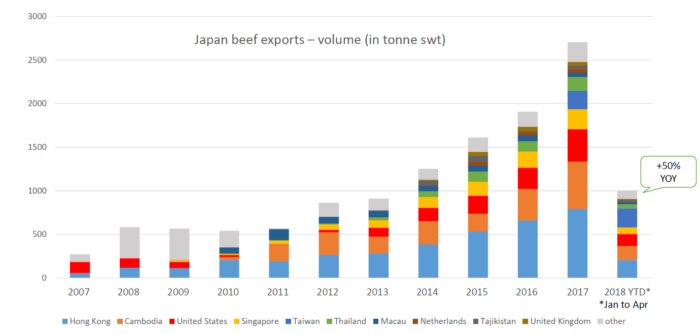
“Prior to BSE in the Japanese herd in 2001, the last full year of Japanese beef exports to Australia was less than 500kg,” said Andrew. “The highest level was around 750kg in the late 1990s.

“Given that things have changed since then and Japan is now more geared toward exports, the output is now around ten times what it was in the late 1990s. The Australian landscape has also changed in that time with a greater foodie culture that would take on products such as Wagyu. The cost of importing Wagyu into Australia would put the Japanese product at a higher price than locally produced Wagyu.

“The feeling in the commercial space is not one of great excitement. Exporting to Australia is more about the kudos for the Japanese beef industry that they have cracked our stringent biosecurity nut and potentially made it easier to transition into other markets. We don’t see Japanese beef imports into Australia as a huge competitor.”

Japanese in-house hurdles

Australia’s biosecurity measures are well known to be one of the toughest in the world and Japanese exporters will still need to ensure that all the accreditation boxes have been ticked before shipments can commence.

The discussion with Andrew and Miho however, suggests that challenges within Japan to be a strong exporter will be more of a hindrance than biosecurity.

It appears that overall Japanese beef production is in gradual decline, with two key reasons. The first is a recent trend for the younger generation to move away from high-end products such as Wagyu for general consumption in preference for leaner, cheaper meats.
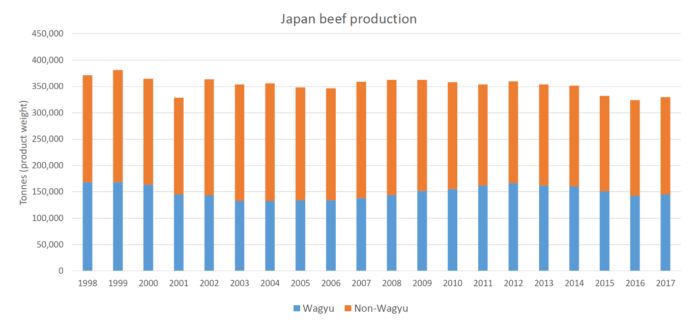
The Ministry of Agriculture, Forestry and Fisheries (MAFF) in Japan aims to maintain 2015 levels of beef production and indications suggest it may be difficult to attain. The best way to ensure long term viability is to intertwine a strong export market and promote greater domestic consumption said Andrew.

This in itself presents a challenge as Japanese beef producers compete and promote products based on their prefecture making it difficult to implement an over-arching government strategy to sell Wagyu to the domestic and international consumer.

“A national strategy makes sense from an export point of view, and successful trade shows into Europe and the US have shown the Japanese government can do it, but with the ongoing disconnect between prefectures, supply and the international strategy, Japan has a few challenges to overcome to develop new export markets. It will be a while yet before it has impact on Australian shores,” said Andrew.

IMPORTANT NOTICE - Terms & Conditions


It is a condition of use of this database that you accept these terms and conditions. 

It is important that you appreciate when accessing the Australian Wagyu Association Limited (AWA) database (which may be hosted on an external website) that the information contained on the AWA database, including but not limited to pedigree, DNA information, Wagyu Breeding Values (WBVs) and Index values (together called Database Information), is based on data supplied by AWA members and/or third parties. 

Whilst sincere effort is made to ensure the Database Information is accurate and complete, to the extent permitted by law, AWA, its officers and employees, shall not be responsible for its use or interpretation, and you use the Database Information at your own risk. Please be aware of the following limitations of the Database Information.  

Regarding WBVs and Index values, it is important to appreciate, and you need to be aware that: 

  • WBVs are derived using genetic evaluation technology developed for the AWA, using the information contained within the AWA database. 
  • WBVs are estimates of genetic potential of individual animals and may not reflect the raw animal phenotype. 
  • WBVs can only be directly compared to other WBVs calculated in the same AWA genetic analysis. 

Regarding pedigree and DNA testing results submitted to the AWA, it is important to appreciate, and you need to be aware that: 

  • Animals whose registration identifiers start with PED are Pedigree Recorded Animals. What this means is that the details which AWA used to register the animal were obtained from a Recognised Wagyu Registry Organisation – in other words a Wagyu breed association based outside of Australia. AWA has not independently verified the information with respect to the animal or the details recorded about the animal. You should read AWA’s by-laws which set out details regarding the definition of a Pedigree Recorded Animal. 
  • Pedigree and DNA data submitted and supplied to AWA may have errors in it which cannot be detected without further DNA testing. 
  • Technology may have advanced since a particular test was undertaken so that genetic issues or inaccuracies which were previously not detectable are now able to be detected by current testing technology (i.e. if the animal was tested again with current technology). 
  • AWA estimates that less than 1% of the pedigree entries, ownership or breeding details in the AWA Herdbook may have errors or which may be misleading. For this reason, users ought to consider if they need to obtain independent testing of the relevant animal (if possible) to ensure that the data is accurate. 

Regarding prefectural content, it is important to appreciate, and you need to be aware that: 

  • Prefectural content is based on the estimation of prefectural origin from Japanese breeding records of 201 foundation sires and 168 foundation dams. As genotype-based parent verification is not used in Japan, and full Japanese registration certificates are not available for all foundation animals, exact prefectural composition for these sires and dams cannot be validated. 
  • The calculation of prefectural content for Australian Herdbook animals relies on the accuracy of pedigree records and DNA samples provided by AWA members.   

Regarding DNA testing and genetic condition results submitted to the AWA, it is important to appreciate, and you need to be aware that: 

  • As genetic testing results are provided by independent DNA testing laboratories at the request of AWA members, AWA relies solely on the accuracy of the reporting of genetic testing as completed by the laboratories. 
  • AWA uses GeneProb software to calculate the likelihood of pedigree animals being a carrier of genetic conditions.  This likelihood is an estimate based on the available genetic testing results. 

If you consider that you do not understand or appreciate the nature and/or implications of the data provided on this website or the WBVs of a particular animal, then AWA strongly recommends that you seek expert advice.  Note there is substantial technical information and articles on the Wagyu website to assist our members. 

AWA’s liability for any loss or damage, consequential or otherwise, suffered or incurred by you or your related business, arising directly or indirectly from your use of Database Information, to the extent permitted by law, is limited to AWA providing you with a refund for the fees paid for the service (if any), or AWA re-performing the service, where possible, at the election of AWA.  

AWA administers this database in good faith to support AWA members and the industry. AWA does not represent or warrant that the animals recorded in this database, or animals breed from them, will achieve any particular genetic or phenotype performance.


THIS DISCLAIMER HAS BEEN UPDATED AS OF 03/02/2026, PLEASE ENSURE YOU HAVE READ IT IN DETAIL