Sale Catalogues 

The Sale Catalogue tool is a free service available to Australian Wagyu Association (AWA) members, allowing them to advertise registered animals, semen, and embryos for sale through the public AWA database.  

Sale Catalogues are publicly accessible, allowing both members and non-members to view sale listings and animal information. 

Using the Sale Catalogue tool provides members with an effective way to promote their sale offerings to the wider Wagyu community, increase visibility among potential buyers, and expand their market reach. Buyers can easily identify animals for sale, access detailed animal information, and view the latest Wagyu Breeding Values (WBVs) as they are updated weekly. 

Preparing Your Sale Catalogue 

To get the best results from your Sale Catalogue, it is recommended that members prepare their sale information before creating a catalogue. 

Before listing animals for sale, consider the following: 

  • Ensure all animals are correctly registered with the AWA and ownership details are up to date. 
  • Review animal names and identification details for accuracy before publishing. 
  • Upload clear, high-quality photos that accurately represent the animals being offered. 
  • Where available, include videos to provide buyers with additional information and improve engagement. 
  • Ensure any relevant pregnancy information, including PTIC (Pregnancy Tested In-Calf) details, is available and clearly communicated. 
  • Confirm all animal records, pedigrees, and genetic condition information are accurate and current. 
  • Ensure adequate time is allowed for DNA testing and results processing prior to the sale, including genetic condition testing and other DNA-based services. 
  • If selling a cow with a calf at foot, the calf should be registered by the breeder before the sale. Calves must be registered under the prefix in which they were born and by the member who owned the dam at the time of birth (then transferred as requested). 
  • Have any sale descriptions, vendor comments, and selling agency information prepared before creating the catalogue. 

Taking the time to prepare this information in advance will help create a more informative catalogue, improve the buyer experience, and present your sale professionally. 

Sale Information 

Sale Catalogues display information entered by the selling member, including: 

  • Member ID 
  • Location 
  • Sale date and time 
  • Selling agency information and contact details 
  • Sale description or information blurb 

Animal Information 

Each listed animal may display the following information: 

  • Animal Association ID 
  • Sex 
  • Pedigree Information 
  • Breeder Feeder Index (BFI) 
  • Genetic condition status and probabilities 
  • Animal description or member comments (optional) 
  • Photos (optional) 
  • Videos (optional) 

Sale Catalogues Search Features 

Viewing Sale Catalogues: 

Within the public database, select the Sale Catalogues tab to view current sale listings. Users can switch between List and Grid views using the buttons located to the right of the search field. 

When viewing a specific catalogue, animal listings can be displayed in the following formats: 

  • Overview – Displays basic animal information, including photos where available. 
  • WBV Table – Allows users to compare animals side-by-side using their WBVs. 
  • Sire WBV Table – Displays registered progeny performance information, assisting users to evaluate sire performance. 

Viewing Advanced Animal Details: 

By selecting an Animal ID within a catalogue, users can access further animal information, including (but not limited to): 

  • WBVs – updated weekly. 
  • Selection indexes 
  • Three-generation pedigree information 
  • Inbreeding percentages 
  • Genomic diversity scores 
  • Bloodline prefecture 

The animal details page can be customised using the Edit Layout button, allowing users to tailor the information displayed to their preferences. 
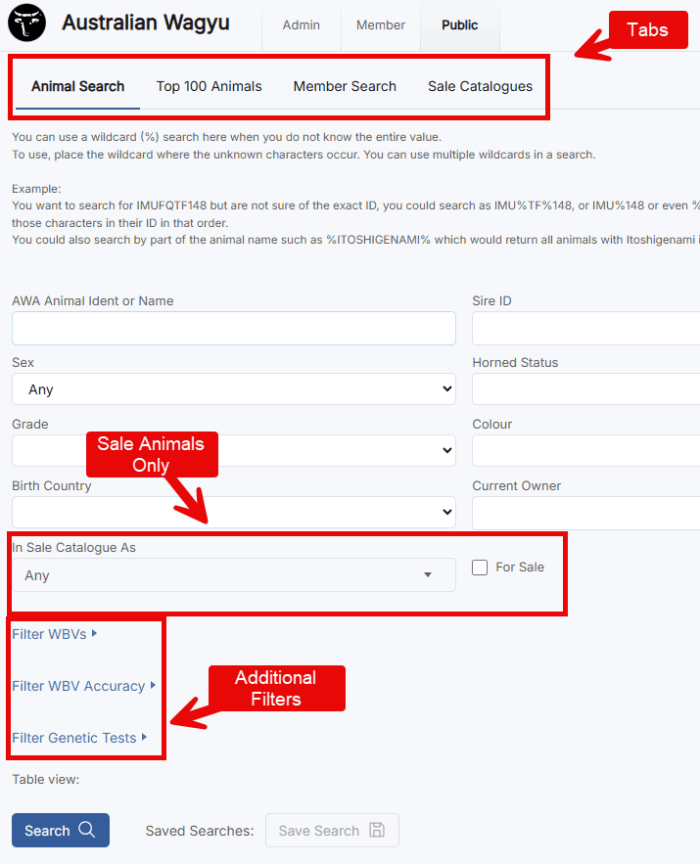
Sale Catalogues Search

Searching for Animals Across Sale Catalogues: 

The Animal Search function within the public database allows users to search for animals across multiple sale catalogues using advanced search criteria. 

Users can filter animals based on: 

  • WBVs 
  • Accuracy percentages 
  • Genetic test results 
  • Sex 
  • Horn Status 
  • Other available search criteria 

By selecting the Animals for Sale option, users can quickly identify sale animals that meet their breeding, genetic, or production objectives, making it easier to locate suitable animals available for purchase.
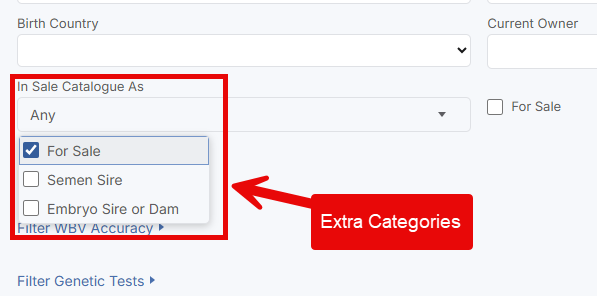
Sale Catalogues Extra Categories

RELATED

Creating A New Sale Catalogue in Helical To create a new catalogue, first select the ‘Sale Catalogues’ module on the left-hand side of the screen. Then click the blue ‘Create… View Article

CATEGORIES

IMPORTANT NOTICE - Terms & Conditions


It is a condition of use of this database that you accept these terms and conditions. 

It is important that you appreciate when accessing the Australian Wagyu Association Limited (AWA) database (which may be hosted on an external website) that the information contained on the AWA database, including but not limited to pedigree, DNA information, Wagyu Breeding Values (WBVs) and Index values (together called Database Information), is based on data supplied by AWA members and/or third parties. 

Whilst sincere effort is made to ensure the Database Information is accurate and complete, to the extent permitted by law, AWA, its officers and employees, shall not be responsible for its use or interpretation, and you use the Database Information at your own risk. Please be aware of the following limitations of the Database Information.  

Regarding WBVs and Index values, it is important to appreciate, and you need to be aware that: 

  • WBVs are derived using genetic evaluation technology developed for the AWA, using information contained within the AWA database and parameters derived from it.
  • WBVs are estimates of genetic potential of individual animals and may change with addition of new data or with new parameters.
  • WBVs are genetic merit estimates only and may not reflect the raw animal phenotype.
  • WBVs can only be directly compared to other WBVs calculated in the same AWA genetic analysis.

Regarding pedigree and DNA testing results submitted to the AWA, it is important to appreciate, and you need to be aware that: 

  • Animals whose registration identifiers start with PED are Pedigree Recorded Animals. What this means is that the details which AWA used to register the animal were obtained from a Recognised Wagyu Registry Organisation – in other words a Wagyu breed association based outside of Australia. AWA has not independently verified the information with respect to the animal or the details recorded about the animal. You should read AWA’s by-laws which set out details regarding the definition of a Pedigree Recorded Animal. 
  • Pedigree and DNA data submitted and supplied to AWA may have errors in it which cannot be detected without further DNA testing. 
  • Technology may have advanced since a particular test was undertaken so that genetic issues or inaccuracies which were previously not detectable are now able to be detected by current testing technology (i.e. if the animal was tested again with current technology). 
  • AWA estimates that less than 1% of the pedigree entries, ownership or breeding details in the AWA Herdbook may have errors or which may be misleading. For this reason, users ought to consider if they need to obtain independent testing of the relevant animal (if possible) to ensure that the data is accurate. 

Regarding prefectural content, it is important to appreciate, and you need to be aware that: 

  • Prefectural content is based on the estimation of prefectural origin from Japanese breeding records of 201 foundation sires and 168 foundation dams. As genotype-based parent verification is not used in Japan, and full Japanese registration certificates are not available for all foundation animals, exact prefectural composition for these sires and dams cannot be validated. 
  • The calculation of prefectural content for Australian Herdbook animals relies on the accuracy of pedigree records and DNA samples provided by AWA members.   

Regarding DNA testing and genetic condition results submitted to the AWA, it is important to appreciate, and you need to be aware that: 

  • As genetic testing results are provided by independent DNA testing laboratories at the request of AWA members, AWA relies solely on the accuracy of the reporting of genetic testing as completed by the laboratories. 
  • AWA uses GeneProb software to calculate the likelihood of pedigree animals being a carrier of genetic conditions.  This likelihood is an estimate based on the available genetic testing results. 

If you consider that you do not understand or appreciate the nature and/or implications of the data provided on this website or the WBVs of a particular animal, then AWA strongly recommends that you seek expert advice.  Note there is substantial technical information and articles on the Wagyu website to assist our members. 

AWA’s liability for any loss or damage, consequential or otherwise, suffered or incurred by you or your related business, arising directly or indirectly from your use of Database Information, to the extent permitted by law, is limited to AWA providing you with a refund for the fees paid for the service (if any), or AWA re-performing the service, where possible, at the election of AWA.  

AWA administers this database in good faith to support AWA members and the industry. AWA does not represent or warrant that the animals recorded in this database, or animals breed from them, will achieve any particular genetic or phenotype performance.


THIS DISCLAIMER HAS BEEN UPDATED AS OF 03/02/2026, PLEASE ENSURE YOU HAVE READ IT IN DETAIL