
Following the release of the first run of Wagyu Breeding Values (WBVs), the Australian Wagyu Association (AWA) is now sharing additional information to support members as they engage with the new genetic evaluation.
Building on information previously released on the principal differences between the genetic evaluations and improvements delivered in AWA’s genetic evaluation the summary below highlights new and important points to assist Wagyu breeders with the change.
- Trait ranges for WBVs
In moving to WBVs, we are also moving the AWA percentile tables to 2024 born claves. The 2024 cohort of registered Fullblood Japanese Black animals now totals around 30,000 individuals. The percentile bands for these animals are shown below and will remain fixed until 2027, when the percentile bands for 2025 born calves will become the reference population for the table.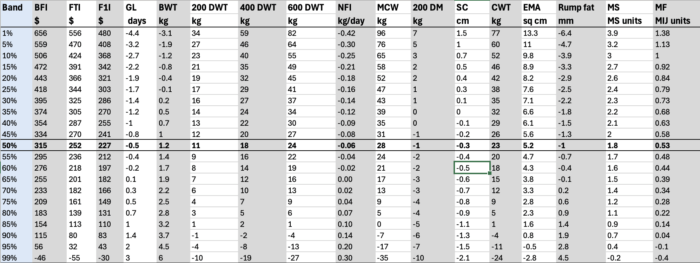
Table 1. Wagyu Breeding Value percentile bands for 2024 born Japanese Black animals.
Trait Definitions: BFI = Breeder Feeder Index, FTI = Fullblood Terminal Index, F1I = F1 Terminal Index, GL = Gestation Length, BWT = Birth Weight, 200 DWT = 200 Day Weight, 400 DWT = 400 Day Weight, 600 DWT = 600 Day Weight, MCW = Mature Cow Weight, 200DM = 200 Day Maternal Weight, SC = Scrotal Circumference, CWT = Carcase Weight, EMA = Eye Muscle Area, MS = Marble Score, MF = Marbling Fineness
VIEW THE PERCENTILE BANDS ON HELICAL
Of note in Table 1, is that the 50th percentile band (the average of the population), changes very little between the currently displayed EBVs for 2023 born calves and WBVs for 2024 born calves. A slight increase in the average Marble Score WBV for 2024 born calves is the largest trait difference between the tables, with year-on-year genetic gain in this trait driving the change. A slight increase in the average Eye Muscle Area WBV for 2024 born calves reflects a change in the application of Wagyu-specific genetic parameters for this trait in the new AWA genetic evaluation.
For most traits, the range in each trait (top 1% to bottom 1%) is similar for WBVs compared to EBVs. We observe a slight increase in range for Marble Score, particularly due to year-on-year genetic gain and focus of breeders on increasing Marble Score in their elite animals.
The trait range for Marbling Fineness is significantly expanded in WBVs, reflecting the shift to using the Meat Image Japan (MIJ) New Fineness Index (2) trait data (around 20,000 records). The MIJ New Fineness Index (2) trait more accurately describes marbling fineness at higher marble score levels. Importantly, the increased range in the Marbling Fineness WBV will assist breeders to make genetic gain for this trait.
- Net Feed Intake (efficiency) WBV
With change to our own genetic evaluation system, AWA is now able to publish a WBV for Net Feed Intake. This WBV is based on 2,000 animal records for Net Feed Intake measured through the Vytelle GrowSafe system. Referring to Table 1, WBVs for the Net Feed Intake (NFI) trait range from -0.4kg/day (most efficient) through to +0.3 kg/day (least efficient). The NFI WBVs reflect the relative genetic merit of animals for efficiency of daily feedlot weight gain. They are calculated as kg difference in feed intake compared to that expected based on body weight and daily gain. Animals with lower NFI WBVs are expected to produce progeny that eat less than expected (are more efficient) for a given level of feedlot performance compared to animals with high WBVs. - Crossbred Wagyu genomic data now used
Many AWA members are undertaking Wagyu Feeder Check testing and have historically done genotyping and provided carcase and liveweight data on F1 and other Wagyu content commercial animals. Due to BREEDPLAN restrictions on genomic data use, crossbred genomic data has not been used in prior BREEDPLAN genetic evaluations. AWA is now able to use both the performance data and the genomic information on all crossbred animals to inform WBVs of sires and dams within the AWA genetic evaluation. This is a major step forward for Wagyu breeders, enabling accurate assignment of genetic merit to Fullblood or Purebred parents, improving WBVs and WBV accuracies. With the change to AWA’s own genetic evaluation, the AWA genetic analysis is using around 100,000 additional genomic profiles (now over 400,000 in total). This has vastly increased the volume and accuracy of data use for the benefit of AWA members. - Overall increase in WBV accuracies
One of the major changes in moving to AWA’s genetic evaluation platform is the ability to use genotype (genomic) information on all animals, including diverse Fullblood and crossbred animals. Previously, the restrictions applied within the BREEDPLAN analysis not only impacted the use of genomic information from crossbred animals, but also diverse Fullblood and Red Wagyu (Akaushi) genotypes, resulting in these genotypes being excluded from analyses. With the move to AWA’s independent genetic evaluation, we have far greater power in the use of crossbred, diverse Fullblood and Red Wagyu genotype data to inform estimation of genetic merit across the entire Wagyu population. As a result, WBVs tend to have higher accuracy, particularly for animals linked to crossbred progeny records and for diverse animals and Red Wagyu whose genotypes had been previously excluded from the BREEDPLAN genetic evaluation. Members will see that the WBV accuracy for trait estimations will mostly be higher than previously reported. As an example, across AWA’s recorded Fullblood and Purebred population, the average increase in accuracy for the carcase weight trait (CWT) has increased by 4%, from 66% (EBV) to 70% (WBV). Animals that already have high accuracy, will typically change less. - Red Wagyu WBVs As a direct result of moving to AWA’s independent genetic evaluation, we are now able to use genotype information for Red Wagyu animals to inform estimation of WBVs for Red Wagyu. AWA had previously held over 1,100 genotypes on registered Red Wagyu animals that were not being used in the BREEDPLAN genetic evaluation for Red Wagyu EBV estimation. Changing to AWA’s independent genetic evaluation enables the use of genomic information for Red Wagyu. As a result, the average accuracy for the Marble Score WBV has increased from 42% to 48.5%, with the average accuracy for Carcase Weight increasing from 50% to 57%. Although we now see significant improvements in the genetic estimation of Red Wagyu within the AWA genetic evaluation, overall numbers of Red Wagyu animals and their performance records with the AWA are still low and hence the accuracy of WBV estimation is still lower than for Japanese Black animals. Submission of additional Red Wagyu data to support the analysis of Red Wagyu for WBVs will have a large impact on Red Wagyu WBVs and accuracies. The AWA is actively seeking to work with Red Wagyu breeders and organisations to increase the data underpinning Red Wagyu WBVs.
Summary
The AWA genetic evaluation system has changed from an externally run BREEDPLAN evaluation, to AWA’s own internally run Wagyu-specific genetic evaluation. This will deliver significant improvements in the use of genomic data from genetically diverse Fullblood Wagyu, crossbred Wagyu and from Red Wagyu.
Overall, the average of the population (50th percentile) for most WBVs will be similar to that published previously, with some slight improvement in trait range for the Marble Score WBV. The majority of incremental change seen in comparison to the published percentile tables is a result of genetic gain across the population moving from a 2023 to 2024 reference population.
Larger changes in animals with crossbred data contributed and for Red Wagyu animals is expected, with genomic data from these animals now used within the AWA genetic evaluation. As a result, accuracies for animals linked to crossbred data or Red Wagyu animals will also increase.
Across the whole database, there is generally an increase in accuracy for WBVs of most animals, with the exception of small changes in already high-accuracy animals.