
The Australian Wagyu Association (AWA) is implementing the most significant upgrade to Wagyu genetic evaluation since the introduction of genomics, transitioning from BREEDPLAN Estimated Breeding Values (EBVs) to Wagyu Breeding Values (WBVs).
From February 2026, WBVs will replace EBVs as the sole breeding values published by AWA. This change reflects how far the Wagyu industry has progressed and ensures that genetic evaluation systems are fully aligned with modern Wagyu production, data scale, and economic drivers.
WBVs are not simply a new label. They represent a Wagyu controlled, Wagyu specific genetic evaluation system, built on the industry’s rapidly expanding datasets, dense genomic information, and advanced carcase measurement technologies. This transition positions Australian Wagyu genetics to remain accurate, relevant, and globally competitive into the future.
To support members through this change, AWA has produced a structured communication series explaining the why, what, and how of WBVs, along with dedicated articles on key trait updates and new genetic tools. This series will be released in the lead up to the launch of WBVs
Why AWA is moving to WBVs
Wagyu production systems now differ fundamentally from those of other beef breeds. Crossbred performance data underpins commercial profitability, genomic information is used at unprecedented scale, and high resolution carcase and eating quality traits are central to selection decisions.
While BREEDPLAN EBVs have provided a strong foundation, the assumptions and constraints of a multi breed system increasingly limited the ability to fully utilise Wagyu specific data. Moving to an independent evaluation allows AWA to unlock the full value of its data, adopt Wagyu relevant trait definitions, and respond more quickly as new information becomes available. READ MORE
What Wagyu Breeding Values are
WBVs describe genetic differences between animals in the same way EBVs do, but they are generated using Wagyu only genetic parameters across a fully integrated multi trait and genomic evaluation.
Most WBVs remain highly correlated with existing EBVs, particularly for growth, carcase weight, and marble score, meaning major re‑ranking is not expected for high accuracy animals. Where change does occur, it reflects corrected Wagyu specific trait relationships rather than instability or noise in the data.
Key improvements include better use of crossbred data, stronger early life accuracy through genomics, faster delivery of results, and the ability to introduce new traits as the Wagyu dataset continues to expand. READ MORE
How WBVs are now possible
WBVs are the result of a four‑year system renewal program, supported by a step change in the scale and maturity of Wagyu data.
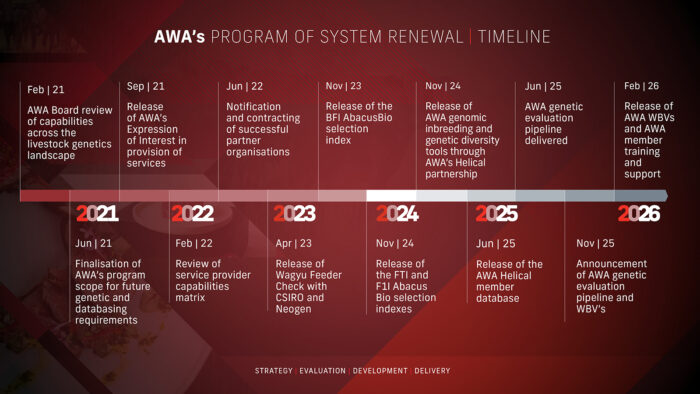
AWA now manages the largest Wagyu genetic evaluation globally, analysing hundreds of thousands of animals across fullblood, purebred, and crossbred populations, supported by extensive genomic coverage. This scale allows genetic parameters, heritabilities and trait correlations to be estimated directly from Wagyu data, rather than relying on legacy assumptions.
By operating its own evaluation pipeline, AWA can update parameters when justified by data, introduce new traits without dependency on external systems, and deliver results more frequently for members. READ MORE
Key trait changes under WBVs
Alongside the broader system transition, several important trait updates and additions are being introduced under WBVs. These changes ensure that results better reflect observed Wagyu performance and modern production objectives.
From Milk EBV to Maternal Weaning Weight WBV
The long standing Milk EBV is being replaced by Maternal Weaning Weight WBV, a clearer and more biologically accurate description of the maternal genetic contribution to calf growth up to weaning.
This change corrects misinterpretation of “milk”, applies Wagyu specific genetic parameters, and delivers results that better align with paddock performance and balanced selection outcomes. READ MORE
From Eye Muscle Area EBV to Eye Muscle Area WBV
The Eye Muscle Area WBV uses updated Wagyu‑specific genetic relationships within a full multi‑trait model, correcting distortions seen under earlier EBV assumptions.
While expressed in the same units, EMA WBVs may re‑rank some animals, reflecting more biologically realistic relationships between muscling, growth, carcase weight, and marbling in Wagyu systems. READ MORE
Introducing Net Feed Intake WBV
For the first time, AWA is introducing a Net Feed Intake (NFI) WBV, giving Wagyu breeders a direct genetic measure of feed efficiency.
NFI identifies animals that consume less feed than expected for their level of production and is independent of growth and body size. This provides a powerful new tool to improve profitability and sustainability in long fed Wagyu systems without compromising carcase performance. READ MORE
Discontinuation of the Retail Beef Yield EBV/WBV
The long‑standing Retail Beef Yield (RBY) EBV is being discontinued and will not be replaced with a Wagyu Breeding Value. The original RBY EBV was built on Angus carcase data and has never been supported by Wagyu‑specific measurements or biology. Within Wagyu systems, the metric used commercially is boxed primal yield, not retail beef yield, because Wagyu primals are fabricated differently across global markets and brand value is tied to wholesale primals rather than retail cut‑out.
Wagyu carcases differ fundamentally from other breeds including extreme intramuscular fat, higher whole‑body fat deposition, unique muscle distribution, and later physiological maturity making RBY an unreliable indicator for Wagyu performance. AWA will instead pursue new research to develop a Wagyu‑appropriate yield trait based on boxed primal yield. Importantly, RBY was not included in AWA selection indexes, so its removal has no impact on index calculations. READ MORE
What happens next?
EBVs will be formally retired in February 2026, after which WBVs will be the sole genetic evaluation published by AWA. The transition is being supported through staged communication, education resources, and member training to ensure breeders can confidently interpret and apply WBVs in their breeding programs.
WBVs represent a future focused genetic framework, designed by Wagyu, for Wagyu ensuring that the Wagyu industry continues to lead globally in genetic evaluation, data utilisation, and long‑term profitability.
At the AWA Technical Workshop in November, we formally announced that the Association will launch its own advanced, independently run genetic evaluation in early 2026.
If you were unable to attend the Technical Workshop, or would like to revisit the presentations, you can watch the full session recordings below: