
Australian Wagyu producers were urged to remain confident, adaptable and globally focused as National Farmers’ Federation (NFF) President Hamish McIntyre addressed delegates at WagyuEdge’26 in April, outlining the opportunities and challenges shaping the future of Australian agriculture.
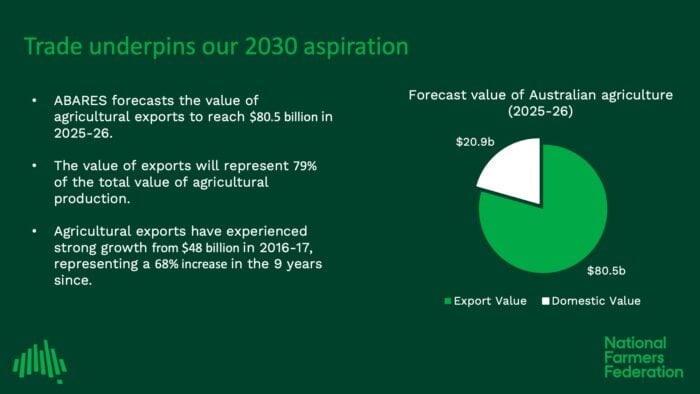
Speaking to producers and industry leaders, Hamish highlighted the critical importance of trade to Australia’s agricultural success, noting that exports remain the lifeblood of the sector. ABARES forecasts agricultural exports to reach more than $80 billion in 2025–26, with exports representing almost 80% of the value of Australian agricultural production.
“Exports are at the heart of nearly every farming business in Australia,” Hamish said, pointing to the red meat sector as a prime example of an industry reliant on strong international market access.
Agriculture Reaches Major Milestone
Hamish reflected on the NFF’s long-term ambition to grow Australian agriculture into a $100 billion industry, a goal now expected to be achieved several years ahead of schedule.
While celebrating this success, he warned that higher industry revenue does not automatically translate into stronger farm profitability. Rising production costs, productivity pressures and increasing input expenses continue to challenge farming businesses across the country.
“The focus now must be on productivity and value-adding,” he said, stressing the need to grow more value from products produced in Australia rather than relying solely on increased production volumes.
Trade Remains Essential
A key theme of the presentation was the importance of maintaining and expanding access to international markets.
McIntyre highlighted the disruption experienced during China’s trade restrictions on Australian exports and said the experience reinforced the need for diversified markets and careful diplomatic engagement.
He noted that despite periods of geopolitical tension, Australian agricultural products continue to be sought after globally because of their quality, reliability and strong production standards.
The NFF remains a strong supporter of meaningful free trade agreements that deliver genuine market access for Australian producers and create opportunities for two-way agricultural trade.
Concerns Over Global Trade Environment
Delegates also heard about growing uncertainty in the global trade landscape.
Challenges include shifting United States trade policies, ongoing geopolitical conflicts and market access concerns in key destinations. Hamish warned that increasing protectionism in some regions threatens the principles of fair and open trade that have underpinned Australian agriculture’s growth for decades.
He expressed disappointment that the recently concluded Australia–European Union Free Trade Agreement did not deliver what the sector considers commercially meaningful gains for agriculture, particularly for beef and sheep meat producers.
Despite these concerns, he acknowledged the broader national interests involved in trade negotiations and emphasised the importance of maintaining constructive engagement with government.
Building Sovereign Capability
Hamish also called for greater focus on Australia’s sovereign manufacturing capability, particularly in areas critical to agriculture such as fertiliser production, fuel security and bio-refining.
He argued that Australia possesses the natural resources and expertise needed to strengthen domestic manufacturing and reduce vulnerability to international supply chain disruptions.
Recent concerns around fuel availability and fertiliser supply have highlighted the importance of ensuring Australia is better prepared for future global shocks.
Opportunity Through Diversification
Looking ahead, Hamish encouraged producers to continue exploring emerging markets and new trade opportunities.
He pointed to India, Southeast Asia and Gulf Cooperation Council nations as regions with significant long-term potential for Australian agriculture. He also encouraged industry to remain engaged with existing trading partners whose ongoing support underpins export success.
“Volatility creates challenges, but it also creates opportunities,” he said.
Diversification, strong international relationships and continued investment in productivity will be crucial to maintaining Australia’s competitive advantage.
Confidence in the Future
Despite the many headwinds facing the sector, Hamish delivered an optimistic message about the future of Australian agriculture.
He praised the resilience and innovation of producers and highlighted the strength of regional communities that continue to support the industry.
“Agriculture remains a wonderful industry,” he told delegates. “We should be proud of what we do and continue working to ensure our businesses and communities remain strong for generations to come.”
His message resonated strongly with the Wagyu sector, where premium production, export market access and global demand continue to create significant opportunities for growth.