Genomic inbreeding measures the actual level of inbreeding present within an animal’s DNA. It does this by analysing the animal’s SNP (Single Nucleotide Polymorphism) profile and identifying long regions of DNA that are homozygous, meaning the DNA inherited from the sire matches the DNA inherited from the dam.
These matching regions, often referred to as Runs of Homozygosity (ROH), occur when both parents pass down the same segment of DNA inherited from a common ancestor. The larger the proportion of an animal’s genome that consists of these homozygous regions, the higher its genomic inbreeding percentage.
Unlike pedigree inbreeding, which estimates inbreeding from recorded ancestry, genomic inbreeding measures the actual DNA inherited by an individual animal. As a result, it can identify variation in inbreeding between full siblings and detect inbreeding that may not be visible in pedigree records.
The Australian Wagyu Association (AWA) maintains the most complete pedigree records available for the Wagyu breed, tracing ancestry back to the foundation animals imported from Japan during the 1990s. However, these pedigrees typically truncate 2–4 generations prior to export. It is well understood that considerable inbreeding existed within the Japanese Black population before exportation. Because this historical ancestry is not fully captured in pedigree records, genomic inbreeding provides a valuable measure of the actual inbreeding present within an animal’s DNA, regardless of whether the common ancestors are recorded in the pedigree.
The genomic inbreeding percentage displayed on an animal profile helps breeders identify the actual level of inbreeding inherited by an animal, enabling more informed breeding decisions and improved management of genetic diversity within their herd.
How Genomic Inbreeding is calculated
Every animal inherits approximately 50% of its DNA from its sire and 50% from its dam. However, the specific DNA segments inherited from each parent are randomly combined during reproduction. This means that while siblings share the same parents, they do not inherit exactly the same DNA and can therefore differ in both performance and genetic composition.
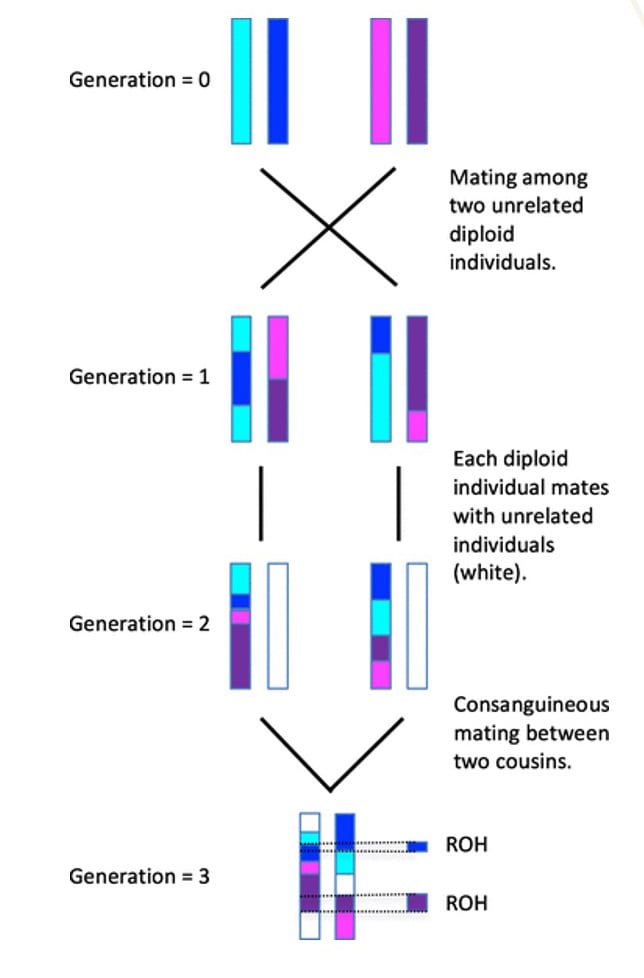
In the example below, Generation 0 represents the original parents. The coloured chromosome segments represent different portions of DNA inherited from each parent.
In Generation 1, two full siblings are produced from the same mating. Although both animals inherit 50% of their DNA from the sire (blue shades) and 50% from the dam (purple shades), the exact DNA segments inherited differ between the siblings. This demonstrates why full siblings can vary in traits despite having the same pedigree.
In Generation 2, these siblings are mated to unrelated animals (shown in white). Their offspring inherit 50% of their DNA from the unrelated parent and 50% from their respective parent. Because the Generation 1 siblings inherited different DNA segments, their progeny also inherit different combinations of the original Generation 0 DNA.
When these cousins are later mated together, some chromosome segments inherited from the original Generation 0 ancestors can be passed down through both the sire and dam lines. Where identical DNA segments are inherited from both parents, regions of the genome become homozygous by descent (identical because they originated from the same ancestor).
Genomic inbreeding is calculated by identifying these regions within the DNA. The larger the proportion of the genome that is identical by descent, the higher the animal’s genomic inbreeding percentage.
Understanding Genomic Inbreeding
Genomic inbreeding and pedigree inbreeding are closely related, but they measure different things.
Pedigree inbreeding estimates the likelihood that inbreeding has occurred based on recorded ancestry, while genomic inbreeding measures the amount of inbreeding actually present within an animal’s DNA.
As a result, two animals with identical pedigree inbreeding percentages can have different levels of genomic inbreeding. This is because siblings inherit different combinations of DNA from their parents, resulting in variation in the amount of homozygous DNA inherited.
As genomic inbreeding increases, a larger proportion of the animal’s genome consists of regions that are identical by descent. This reduces genetic diversity within the animal because fewer alternative gene variants are present.
As a general rule:
- Higher genomic inbreeding indicates lower genetic diversity within the individual animal.
- Animals with similar pedigree inbreeding can have very different genomic inbreeding levels.
- Genomic inbreeding can detect historical inbreeding that may not be visible in pedigree records.
- Higher genomic inbreeding increases the likelihood that harmful recessive variants may be expressed.
Limitations
While genomic inbreeding provides a more accurate measure of actual inbreeding than pedigree-based calculations, there are also some limitations to consider.
Genomic inbreeding is calculated using thousands of SNP markers spread across the genome. While this provides a highly accurate representation of inbreeding, it remains an estimate of whole-genome inbreeding rather than a direct measurement of every DNA sequence within the genome.
The accuracy of genomic inbreeding calculations also depends on the quality of the genomic sample. Genomic inbreeding is only calculated for animals with a SNP call rate greater than 95% (0.95). Samples with lower call rates may not contain sufficient genomic information to accurately identify regions of homozygosity and therefore will not receive a genomic inbreeding value.
Additionally, genomic inbreeding identifies regions of homozygosity but does not indicate whether the genes contained within those regions are favourable or unfavourable. Two animals may have similar genomic inbreeding percentages but differ considerably in performance, productivity and genetic merit.
For this reason, genomic inbreeding should be considered alongside other breeding tools, including Wagyu Breeding Values (WBVs), pedigree inbreeding values and genetic diversity measures when making selection and mating decisions.
Why Inbreeding Matters in Wagyu
Inbreeding increases the likelihood that an animal inherits identical copies of DNA from common ancestors, reducing genetic diversity within the population.
Animals with high levels of inbreeding may experience reduced:
- Developmental growth
- Fertility
- Survival
Animals also carry recessive genetic variants that may not affect performance when only one copy is present. As inbreeding increases, there is a greater chance an animal inherits identical copies of these variants from a common ancestor, increasing the likelihood that harmful genetic defects are expressed.
While linebreeding can be used to concentrate desirable genetics within a herd, excessive use of closely related animals can increase inbreeding levels over time. Introducing less-related or outcross animals can help maintain genetic diversity and reduce the accumulation of inbreeding.
Therefore, managing inbreeding within the herd is vital for overall herd performance and welfare.
Key takeaway
Pedigree inbreeding predicts the likelihood of shared ancestry based on a family tree, whereas genomic inbreeding measures the actual DNA inherited by an animal. As a result, genomic inbreeding provides a more accurate picture of the true level of inbreeding present within an animal and can reveal differences between full siblings that are not visible from pedigree records alone.