Wagyu Breeding Values (WBVs) estimate an animals true genetic potential for specific traits. Each WBV is accompanied by an accuracy percentage, which shows how reliable that estimate is or how close the estimate is to the true breeding value.
Accuracy also reflects the amount and quality of information used in the calculation.
Traits with higher accuracy values are generally based on more extensive data and are therefore more reliable estimates.
Influencing Accuracy
Accuracy figures are calculated using a range of data sources, including:
- Genomic profiles
- Pedigree
- An animals own performance records in a contemporary group
- The performance of all known relatives (sire, dam, siblings, progeny)
- The performance of other animals with similar DNA profiles.
- The genetic correlations between traits and the trait heritability
Accuracy can increase over time when additional data becomes available from the above sources. Generally, the more information available, the more precise and reliable the WBVs become.
Accuracy Guide
Use this scale to interpret WBV accuracy levels:
| Accuracy % | Interpretation | Reliability Level |
| Below 50% | Preliminary estimate | Modest reliability |
| 50-74% | Moderate data available | Medium reliability |
| 75 – 90% | Strong data support | Medium to high reliability |
| 90%+ | Extensive data available | Very high reliability |
Helpful Hint: When selecting an individual animal (i.e. influential sire, donor cow, AI sire), a “good” WBV with modest accuracy should be interpreted with caution, as it may shift up or down) as more data becomes available. Higher accuracy values provide greater confidence in the stability of the estimate and lower general risk associated with WBV changes.
How to Manage the Risk of Modest to Moderate WBV Accuracy
An important strategy to manage WBV accuracy is taking a team approach rather than relying or focusing heavily on an individual young or low accuracy of animals. Using a team (or population) approach naturally spreads the genetic risk, reduces the impact of unexpected WBV changes for any single animal and creates a more stable pathway for herd improvement. For example, figure 1 shows that the WBV accuracy of a team, is much greater than an individual, with this example based on an individual with an WBV of 50% accuracy.
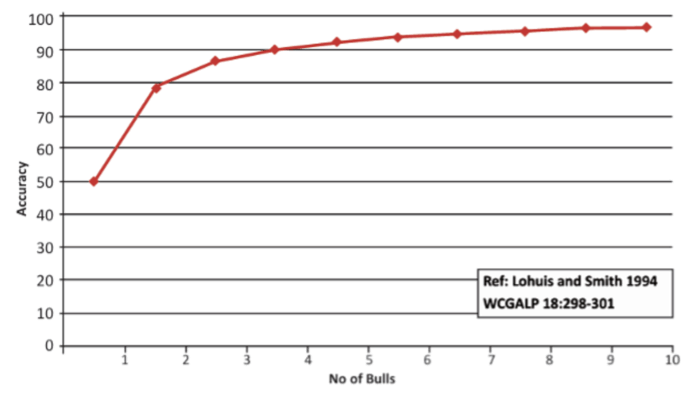
Figure 1. Considering a team approach will reduce the risk of WBV change, through higher accuracy for the’ team’ compared to the individual (graphic based on an individual EBV accuracy of 50%).
From a sire perspective, a ‘team’ may combine proven, high accuracy sires with younger genomically tested sires that offer fresh genetic options. Distributing matings across several bulls ensures no single WBV change has an outsized impact on herd direction.