Carcase data is one of the most valuable sources of information available to Wagyu breeders. It provides direct measurement of the carcase traits that influence eating quality, market specifications and commercial value, many of which cannot be accurately assessed in a live animal.
When carcase records are linked to pedigree information, they contribute to the calculation of Wagyu Breeding Values (WBVs) and indexes, increasing the accuracy of genetic evaluations and supporting more effective breeding decisions. Consistent, accurate and well-structured carcase data collection is essential for identifying superior genetics and driving ongoing genetic improvement within the Wagyu breed.
Recording and Submitting Carcase Data
Carcase data is typically collected at the processing plant during slaughter and grading. Members can request a copy of this data from the processor and collate the information using the Australian Wagyu Association (AWA) Carcase Data Submission Template for inclusion in the genetic evaluation.
Accurate animal identification is essential for successful carcase data submission. In Australia, we recommend that the National Livestock Identification System (NLIS) tag is scanned and linked to the corresponding body number throughout the production process. The NLIS number is a key identifier used to match carcase records to individual animals and their pedigree information.
For international members, a unique electronic identification (EID) (preferred method) or other traceable animal identification number should be maintained throughout processing and linked to the corresponding carcase records. Regardless of the identification system used, maintaining a clear link between the live animal and its carcase information is critical to ensure data can be accurately matched and included in the genetic evaluation.
To ensure carcase data can be correctly attributed, members should maintain accurate and up-to-date animal identification records within their herd and the AWA recording systems. Consistent identification practices help maximise the value of submitted data and support the accuracy of Wagyu Breeding Values (WBVs).
Collecting Trait Information
The AWA database can record a wide range of carcase performance and meat quality traits. These measurements may be collected through conventional chiller assessment, laboratory analysis or objective camera imaging systems, depending on the processing facility.
The following carcase traits can be submitted to the AWA database for recording:
| Code | Description | Value Format |
| CBID | Carcase Body Number | Body number allocated by the processing plant |
| DOF | Days on Feed | Number of days in feedlot |
| CQTR | Carcase Quarter Site | The lowest rib number at the site of quartering and grading. If cut at 12th/13th, then enter 12 and the same for 5th/6th, enter 5. |
| CDPI | Carcase Dentition – no of permanent incisors | Number of permanent incisors 0-8 |
| COSS | Carcase Ossification score | Grading score 100-590 |
| CWT | Carcase Hot Weight (kg) | Weight for whole body |
| CP8 | Carcase P8 Fat (mm) | P8 (or Rump) fat mm 0-55 |
| CMAU | Carcase Marble Score – AusMeat | AusMeat scale 0-9+ score |
| CMMS | Carcase Marble Score – MSA/USDA | MSA/USDA score (100-1190) |
| CIMF | Chemical Intramuscular fat % | Laboratory chemically extracted % 0.0-85.0 |
| CEMA | Carcase EMA (cm2) | Square. centimeters 10-180 |
| CRIB | Carcase Rib Fat (mm) | Rib fat in millimeters 0-55 |
| CMTP | Carcase Meat Temperature (EMA) | Carcase Meat Temperature (EMA) 0.0 – 9.9 |
| CCRA | Carcase Camera Ribeye Area | CMBL Rib-Eye Area 10.00-180.00 |
| CCMP | Carcase Camera Marbling % | CMBL Marbling % 0.00-85.00 |
| CCFI | Carcase Camera Fineness Index | CMBL Fineness Index- 1.000-5.000 |
| CJMP | Carcase MIJ30 Marbling % | DMp % 0.00-85.00 |
| CJFI | Carcase MIJ30 Fineness Index | DMf 0.00-15.00 |
| CJRA | Carcase MIJ30 Ribeye Area | DMa 10.00-180.00 |
Note: While the AWA database has the capability to record all of the traits listed above, not all traits are currently included in the Wagyu genetic evaluation. However, these records remain valuable and may be incorporated into future genetic analyses as additional data becomes available.
Carcase Traits analysed within the Wagyu Breeding Values
To be included in the genetic evaluation, animals with recorded carcase data must generally be aged between 300 and 1,400 days at slaughter and are registered. Carcase records submitted within this age range contribute to the calculation of carcase WBVs, providing an estimate of an animal’s genetic potential for economically important carcase traits.
The current Wagyu genetic evaluation includes the following carcase traits:
- Carcase Hot Weight (CWT)
- Carcase Eye Muscle Area (EMA)
- Carcase Rump Fat (P8)
- Carcase Marbling (AUS-MEAT Marble Score)
- Carcase Camera Ribeye Area
- Carcase Camera Marbling %
- Carcase Camera Fineness Index
These traits provide valuable information on an animal’s genetic merit for carcase performance and quality. When combined with pedigree and performance information from related animals, they help identify genetics that are more likely to produce desirable carcase outcomes in future generations.
Improving the Quality of Your Carcase Data
Contemporary Groups – Formation and Lifetime Flow on Effect
One of the most important considerations when submitting carcase data is ensuring contemporary groups remain effective. Within the Wagyu Genetic Evaluation, animals are categorised according to a range of non-genetic factors to form contemporary groups. Contemporary groups identify animals that have had an equal opportunity to perform, allowing their records to be compared fairly. Importantly, contemporary grouping is not limited to a single measurement event. Group allocations can carry through an animal’s lifetime, meaning management decisions made at any stage may influence contemporary group structure and the usefulness of subsequent performance records, including carcase data.
Contemporary Groups and Carcase Data Analysis
For carcase records to contribute effectively to the Wagyu Genetic Evaluation, animals must be compared against appropriate contemporary groups. Contemporary groups identify animals that have had an equal opportunity to perform, allowing differences in carcase performance to be more accurately attributed to genetic merit rather than environmental or management influences.
Contemporary groups are established throughout an animal’s lifetime using factors such as herd, birth year, sex, birth type (single or twin), and whether the animal was bred through ET or Natural/AI mating. These historical groupings form the foundation for how carcase records are ultimately analysed within the genetic evaluation.
When carcase data is analysed, animals are grouped based on factors including:
- Slaughter date
- Management group
- Age slicing (60-day age spread)
These factors help ensure differences in carcase performance are not simply the result of age, management or processing conditions, allowing genetic differences between animals to be more accurately identified.
For example, if a contemporary group of 20 animals is processed across two slaughter dates, with 10 animals processed on one day and 10 the following day, the original group may be divided into two separate contemporary groups for analysis. As groups become smaller, there is less information available to accurately compare animals, which can reduce the value of the submitted data within the genetic evaluation.
To maximise the usefulness of carcase data, producers should aim to submit records from complete management groups that have been managed and processed under similar conditions wherever possible.
Contemporary Groups –Why Size Matters
The effectiveness of carcase data within the genetic evaluation is influenced not only by how contemporary groups are formed, but also by the number of animals within each group. Larger contemporary groups provide more information for genetic evaluation, improving the ability to separate genetic differences from environmental influences.
One of the most common ways contemporary group size is reduced is through differing observation dates. For example, animals that have been managed together throughout their lives may be slaughtered over several kill dates due to processor scheduling or market requirements. While this may be operationally necessary, it can reduce the number of animals available for comparison within each contemporary group.
As a general guide, the greatest gains in information value occur when moving from very small contemporary groups to moderate-sized groups:
- 2-5 animals: Limited information available for comparison
- 10-20 animals: Substantial improvement in evaluation effectiveness
- 20-40 animals: High level of comparative information
- More than 40 animals: Further improvements occur, although at a slower rate
When planning carcase data collection, breeders should consider the impact of management and processing decisions on contemporary group size. Maintaining larger groups wherever practical helps maximise the value of the data submitted and strengthens the resulting Wagyu Breeding Values (WBVs).
Sire Representation
While contemporary group size is important, the number of sires represented within a contemporary group is equally critical. Contemporary groups containing progeny from multiple sires provide the strongest genetic links and allow for more accurate comparisons between animals.
When a contemporary group contains progeny from only one sire, it becomes difficult to determine whether differences in performance are due to genetics or environmental factors. In contrast, groups containing progeny from several sires provide greater opportunity to compare sire performance under the same management and environmental conditions.
For this reason, breeders are encouraged to submit carcase data from contemporary groups that contain progeny from multiple sires wherever possible. Larger numbers of progeny per sire also improve the amount of information available for genetic evaluation and can increase the accuracy of WBVs.
Carcase Processing Considerations
The value of carcase data within the Wagyu Genetic Evaluation depends on measurements being collected consistently and in accordance with recognised industry protocols. Before submitting carcase data, members should understand how measurements are collected by the processing plant and ensure the data is suitable for genetic evaluation.
Where possible, animals should be processed through a Meat Standards Australia (MSA) licensed abattoir, with measurements collected by an MSA-accredited grader. Consistency is important, and it is best practice for all animals within a contemporary group to be assessed by the same grader. Where multiple graders are involved, separate management groups should be considered to minimise the potential impact of grader bias.
Breeders should also be aware that some routine processing procedures may affect the accuracy or usefulness of carcase measurements, including:
- Hide puller damage: where fat is inadvertently removed from the carcase during hide removal, potentially affecting fat measurements.
- Heavy fat trimming: where fat is removed prior to assessment, particularly around measurement sites such as rib fat.
- Carcase damage or bruising: where bruised tissue or abscesses are removed from the carcase, influencing recorded measurements.
Consistency within contemporary groups is equally important. Animals should ideally be assessed using the same grading protocols, quartered at the same site, and processed under similar chilling and handling conditions. Maintaining consistency helps ensure differences in recorded performance reflect genuine biological differences between animals rather than variation introduced through processing and assessment procedures.
The key to submitting high-quality carcase data is understanding plant processes and carefully reviewing the information supplied by the processor before submission. Measurements should be checked to ensure they fall within expected ranges and are representative of the animal’s true performance.
Measuring Carcase Traits
AUS-MEAT Assessment
AUS-MEAT grading remains the industry standard for assessing carcase quality in Australia and provides many of the traits currently used within the Wagyu Genetic Evaluation. Qualified graders assess traits such as marble score, eye muscle area, rib fat, P8 fat and ossification using standardised procedures that ensure consistency across processing plants.
For marbling assessment, AUS-MEAT graders visually score carcases using the AUS-MEAT marbling scale. While this system has been widely adopted and provides valuable information for both commercial and genetic purposes, Wagyu cattle frequently achieve very high levels of marbling. As a result, many elite Wagyu carcases may receive marbling scores at or above the upper end of the AUS-MEAT scale, making it more difficult to distinguish differences between highly marbled animals.
MIJ Camera Imaging
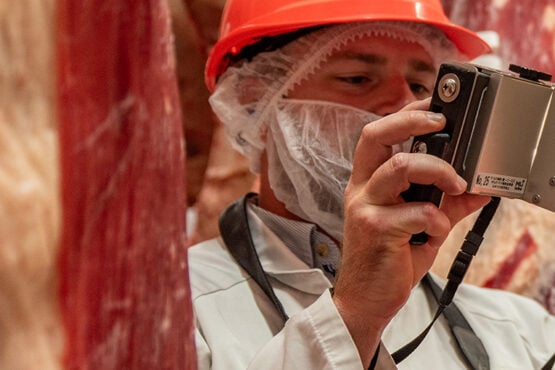
Objective camera technologies, such as the MIJ-30 camera system, have become an important tool for measuring carcase traits in Wagyu cattle. These systems use computer image analysis technology to objectively assess traits including marbling percentage, eye muscle area and marbling fineness.
One of the key advantages of objective camera measurements is their ability to provide additional differentiation among highly marbled carcases. While many Wagyu carcases can achieve AUS-MEAT marbling scores of 9 or higher, camera systems quantify the actual amount and distribution of intramuscular fat, allowing meaningful differences to be identified between animals that may receive the same visual marbling score.
As a result, MIJ camera measurements can provide a more detailed description of carcase quality and generate additional information that may support genetic evaluation and selection decisions. When used alongside traditional AUS-MEAT assessments, objective imaging technologies contribute to a more comprehensive understanding of Wagyu carcase performance.
Key Take Home Messages
- Collect carcase data from as many eligible animals as possible rather than selectively recording only the highest or lowest performers.
- Maintain accurate animal identification records to ensure carcase data can be correctly matched to pedigree information.
- Effective contemporary groups are critical. Management decisions and observation dates can influence contemporary groups throughout an animal’s lifetime.
- Larger contemporary groups and strong sire representation provide more valuable information for genetic evaluation.
- Process animals under consistent conditions wherever possible and review processor-supplied data before submission.
- AUS-MEAT grading and MIJ camera imaging provide complementary sources of carcase information, with objective camera technologies offering additional discrimination among highly marbled Wagyu carcases.
- High-quality carcase data contributes to more accurate Wagyu Breeding Values (WBVs) and supports ongoing genetic improvement within the Wagyu breed.